The process of digital marketing for growing SMEs
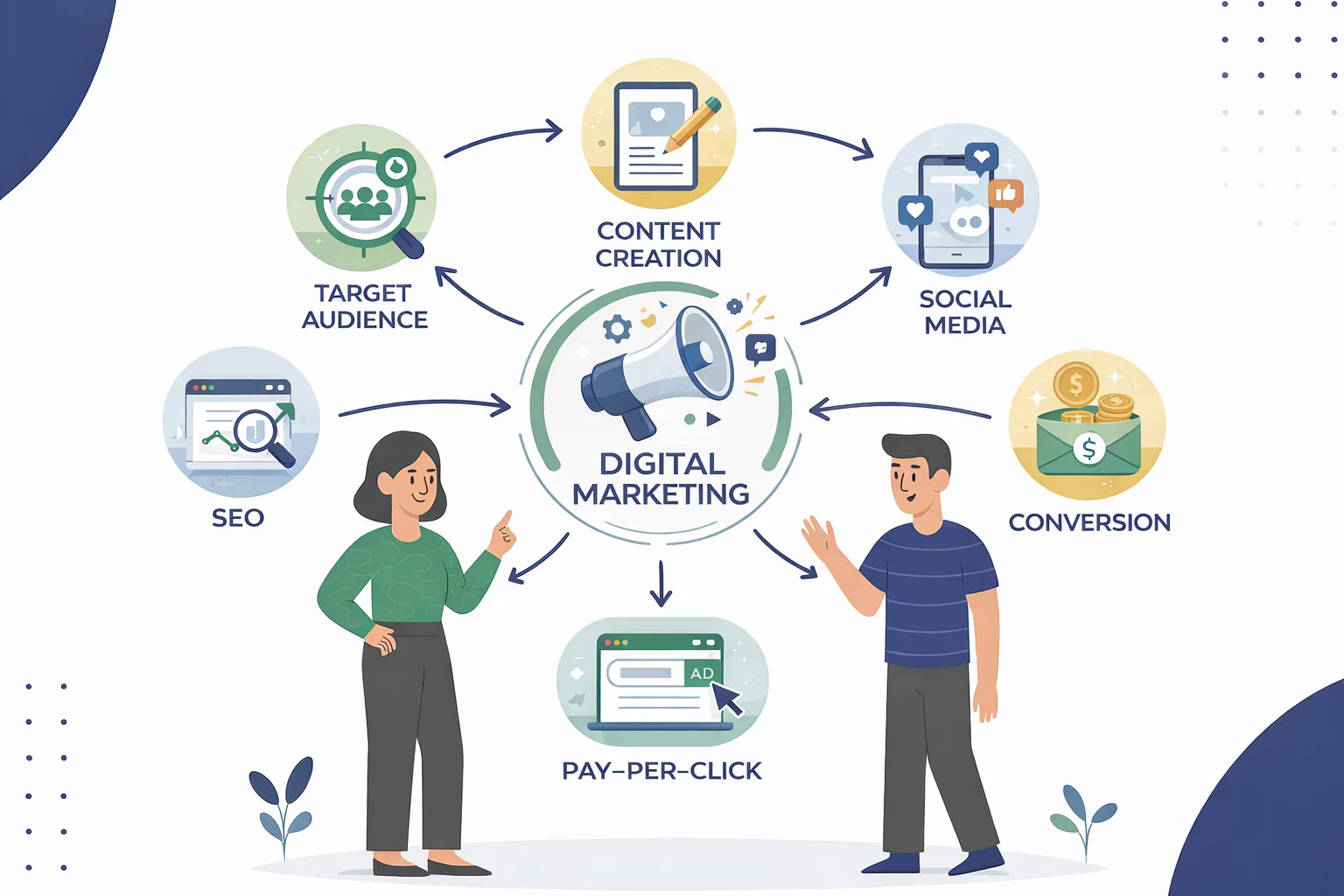
The real process of digital marketing is the structured system behind your digital marketing strategy, your marketing efforts, and your ability to execute across multiple digital marketing channels without chaos.
Digital marketing refers to the use of digital channels, digital platforms, and digital technology to reach your target audience, generate leads, and drive measurable business growth. But without structure, activity becomes noise.
An effective digital marketing strategy connects:
- Clear marketing objectives and business goals
- The right mix of digital marketing channels
- Measurable key performance indicators
- Ongoing optimisation based on performance data
That is where most SMEs break down.
Why the typical digital marketing process fails
Most online explanations of the digital marketing process assume you have:
- A full marketing team
- Dedicated digital marketers
- Seamless customer relationship management systems
- Clean reporting through Google Analytics
- Integrated project management software
Growing SMEs often have fragmented marketing activities, scattered tools, and inconsistent marketing messages.
The result:
- Disconnected digital marketing campaigns
- Reactive social media posts
- Underperforming Google Ads and other paid advertising
- Weak integration between content marketing, email marketing, and search engine optimisation
The problem usually sits in the operating structure rather than the effort behind the work.
What the process of digital marketing should include
A robust digital marketing strategy rests on four connected layers.
1. Digital marketing strategy before channel choice
A digital marketing plan must begin with:
- Defined digital marketing goals
- Alignment with overall marketing strategy
- Clear business goals
- Defined buyer personas and mapping of the buyer’s journey
Without this, your digital marketing efforts become isolated tactics.
Effective digital marketing strategy determines:
- Which marketing channels matter
- Whether inbound marketing or outbound paid ads are the priority
- Where traditional marketing or even selective offline marketing such as direct mail fits
Digital strategy is not about doing everything. It is about doing the right things in sequence.
2. Search visibility as foundation
Your process of digital marketing must include structured search engine optimisation and search engine marketing.
This includes:
- Strategic keyword research
- Technical SEO and technical seo improvements
- Authority building through relevant content
- Clear site architecture and high-performing landing pages
- Targeted Google Ads or other paid advertising where appropriate
Search engines remain one of the highest intent digital marketing channels.
Without visibility here, other digital marketing efforts are harder and more expensive.
3. Content and social as compounding assets
Content marketing is not publishing random articles.
It is building a content strategy that delivers valuable content across multiple digital platforms.
This includes:
- Long-form content aligned to search intent
- Structured social media marketing
- Planned social media campaigns
- Targeted social media advertising and paid social ads
- Consistent social media management
Organic social media builds credibility.
Social media ads increase reach.
Influencer marketing may support awareness in certain sectors.
The goal is not constant posting. It is structured amplification.
4. Conversion and retention systems
A successful digital marketing campaign does not stop at traffic.
The digital marketing process must integrate:
- Conversion-focused landing pages
- Structured email marketing
- CRM-driven follow-up through customer relationship management
- Measurement of customer lifetime value
- Marketing automation to support existing customers
Digital marketing efforts should generate leads, nurture prospects, and convert them without relying on manual intervention every time.
Digital marketing channels in context
There are many digital marketing channels:
- Search engines
- Social media platforms
- Email marketing
- Paid ads and digital ads
- Search engine marketing
- Influencer marketing
- Content marketing
Effective digital marketing depends on selecting channels that align with your marketing objectives and target audience, then giving each channel a clear role in the wider system.
Traditional marketing and offline marketing still have a place for some sectors, but internet marketing and online marketing dominate where buyers research on digital devices before making decisions.
Measurement inside the digital marketing process
The process of digital marketing must include structured measurement.
That means:
- Defined key performance indicators
- Clear reporting dashboards
- Interpretation of digital data, not vanity metrics
- Review of digital marketing campaigns against marketing objectives
Tools such as Google Analytics, CRM systems, and marketing automation platforms support this. But tools alone do not create clarity.
Marketing tools amplify whatever strategy you already have. If the structure is weak, automation accelerates confusion.
From digital marketing activity to operating infrastructure
Many businesses run digital marketing campaigns. Few operate a fully integrated digital marketing process.
Activity looks like:
- Sporadic social media posts
- One-off marketing campaigns
- Disconnected paid advertising
- Standalone email marketing sends
Infrastructure looks like:
- A documented digital marketing plan
- SEO integrated with content marketing
- Social media campaigns aligned with search visibility
- Paid advertising reinforcing organic performance
- Measured digital marketing efforts tied to revenue
That is the difference between scattered marketing activities and an effective digital marketing strategy.
Where most SMEs need to strengthen their marketing process
If you searched for “process of digital marketing,” your issue is likely one of these:
- Weak search engine optimisation
- Underperforming digital ads
- Poor alignment between digital marketing channels
- Inconsistent social media marketing
- No structured content strategy
- Disconnected marketing materials
- Lack of clarity in marketing goals
The solution is rarely another digital marketing course. It is rarely a new tool.
It is building a marketing process that connects strategy, channels, execution, and measurement.
What to fix first if your marketing process is breaking down
If your traffic is weak but demand exists, start with SEO visibility.
If your message, structure, or conversion path is unclear, start with a website refresh.
If your team is buried in repeated drafting, admin, or inconsistent content workflows, start with AI setup or second-brain support.
For many SMEs, adding another campaign only increases the noise. The strongest gains usually come from identifying the system constraint that is holding performance back, then fixing it in the right order.
Building an effective digital marketing strategy that holds
A robust digital marketing strategy for SMEs typically involves:
- Strategic audit of existing digital marketing efforts
- Alignment of marketing objectives with business goals
- Structured channel selection across digital channels
- Implementation across search engines, social media platforms, and email marketing
- Ongoing optimisation based on performance data
Digital marketing focuses should be defined by revenue impact, not trend cycles.
The process of digital marketing becomes resilient when it is built as a system rather than a checklist.
Digital marketing will continue to evolve as digital technology changes. Algorithms shift. Digital devices multiply. Social platforms change reach rules, advertising platforms update approval and targeting policies, privacy rules affect tracking, and search engines adjust how content is evaluated.
Your marketing process must be able to adapt.
That is the real meaning of the process of digital marketing.
It is not just a list of steps. It is a structure for making better decisions, measuring what is working, and improving each campaign with the evidence from the last one.
That is compounding performance: stronger search visibility, clearer messaging, better conversion paths, and content that becomes easier to reuse over time.
Explore free guides, checklists and templates