Artificial intelligence marketing: strategy, tools, and best practices
Artificial intelligence marketing needs ownership
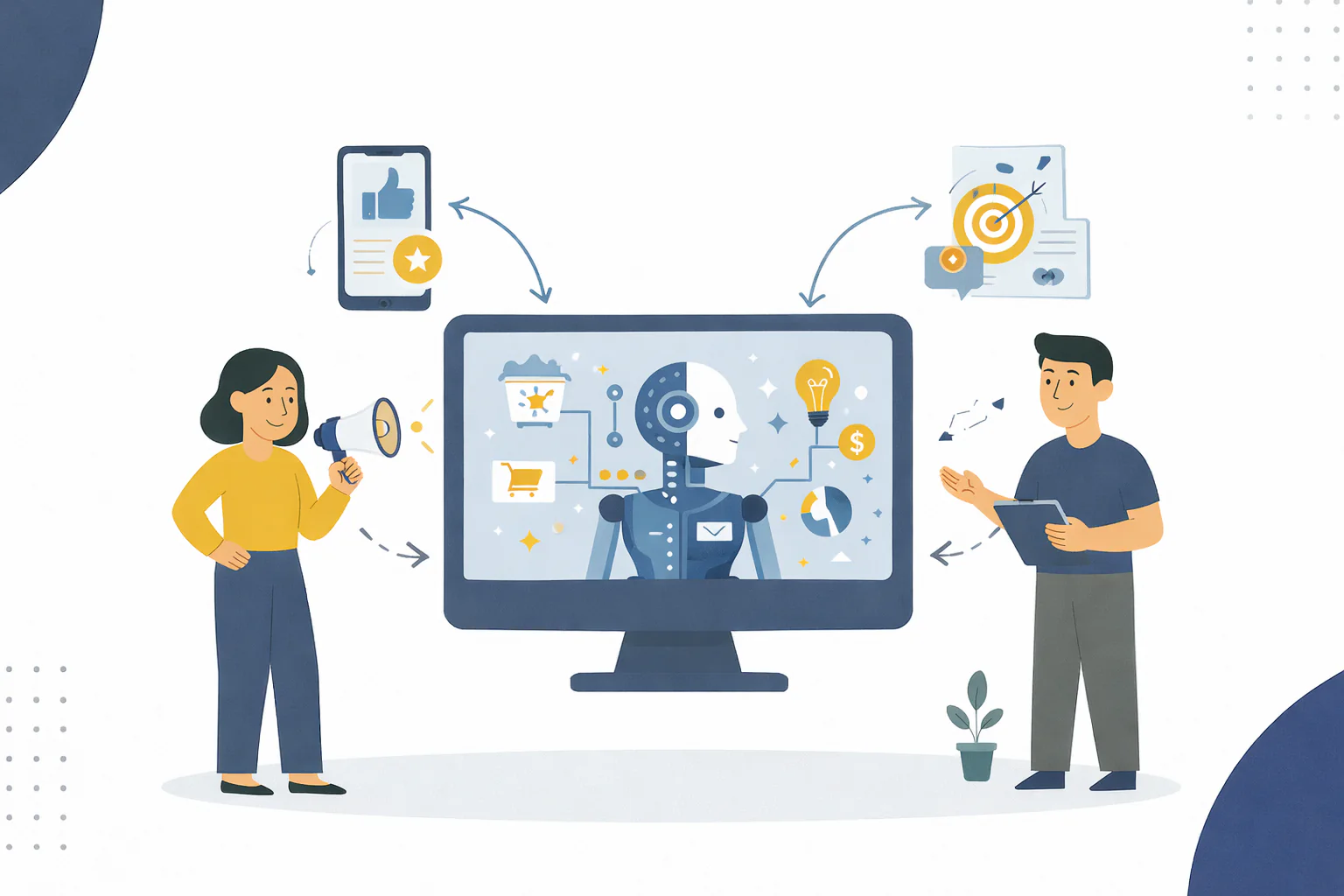
Artificial intelligence marketing is no longer a separate experiment for most businesses. AI now appears in writing tools, analytics dashboards, search platforms, CRM systems, email software and planning workflows. The challenge is not access to AI. The challenge is ownership.
Without ownership, AI marketing becomes a collection of disconnected shortcuts. One person uses it for social posts, another uses it for reports, another uses it to rewrite web copy, and nobody is sure what the business has approved. That creates inconsistency, duplicated work and avoidable risk.
A stronger approach treats AI marketing as an implementation system. Someone decides what AI is for, where it belongs, how source material is used, who reviews outputs, and how the work connects to visibility, engagement and sales follow-up.
AI in marketing is most useful when it supports a clear digital marketing strategy: understanding customers, improving campaign planning, and helping teams act on data without losing human judgement. AI adoption should not start with buying more software; it should start with deciding where AI powered tools can genuinely improve customer insights, content quality and decision making.
If organic visibility is one of the goals, AI should support the same fundamentals covered in the complete guide to SEO for small businesses: clear structure, useful content, technical basics and consistent review.
Start with artificial intelligence marketing strategy, not software
Tool selection matters, but it should not be the first decision. Before choosing a platform, define what the marketing system needs to do. A practical AI tools evaluation checklist can help you test whether a tool genuinely supports the workflow before it becomes part of your stack.
Useful strategy questions include:
- Which audiences are we trying to reach?
- What decisions do they need help making?
- Which pages, articles or assets already support those decisions?
- Where does our content process slow down?
- What information does the team repeatedly recreate?
- Which customer-facing outputs require extra review?
- What should happen after someone engages with our content?
These questions keep AI tied to business reality.
They also stop your team from buying tools to compensate for unclear positioning or weak process.
Map the workflow before adding AI
A practical AI marketing workflow starts by mapping how marketing work currently happens across planning, drafting, approval, publication and review. For example, a content workflow might move through topic selection, search review, source gathering, drafting, editing, approval, upload, internal linking, publication and performance review.
Once that workflow is visible, it becomes easier to choose where AI can help. AI might summarise source notes, create a first draft, suggest metadata, identify related internal links, convert a guide into email copy, or prepare a checklist for review. It should not silently take over the whole process.
This is the difference between automation and implementation. Automation asks, “What can we make the tool do?” Implementation asks, “How should this work move through the business?”
Choose artificial intelligence marketing tools by role
AI tools are easier to assess when each one has a defined role.
You might need one tool for writing, another for data analysis, another for meeting notes, and another for workflow management. Or you might need a simpler setup with fewer moving parts.
Common roles of AI marketing tools include:
- Research support: gathering themes, summarising source material and identifying customer questions.
- Content production: turning briefs into first drafts, variants, outlines and repurposed assets.
- SEO support: structuring pages, metadata, internal links and topic coverage for search visibility.
- Operational support: checklists, task routing, reminders, reporting summaries and documentation.
- Engagement support: nurture emails, response templates, onboarding content and handover notes.
HelixScribe can support structured content creation and workflow momentum.
Claire Nicholson Digital focuses on the system around the tools: how they fit the business, what they should produce, and how people should use them responsibly.
Use AI to understand customer data, not just create content
AI can help marketers analyse consumer data from website behaviour, purchase history, customer feedback, search enquiries, CRM notes and email engagement. The value is not just more data; it is turning historical customer data into actionable insights.
For example, predictive analytics can help identify purchase patterns, likely repeat purchases, churn risk, audience segments or the next best action for a customer group. Sentiment analysis can also help you spot recurring concerns, objections or positive themes across surveys and support conversations.
This kind of data driven decision making helps you tailor messages to target audiences with greater precision. It also helps marketing leaders see which customer experiences need more attention, which services create the strongest demand, and where digital marketing campaigns can be improved.
Common AI in marketing use cases
AI in marketing works best when each use case has a clear purpose. Useful applications include:
- drafting social media posts and campaign variants for different social media platforms
- creating personalised email campaigns from defined audience segments
- turning long-form content into product descriptions, landing pages or short videos
- supporting marketing automation and campaign management
- using recommendation engines on e-commerce sites
- running audience segmentation for different customer groups
- powering chatbots or virtual assistants for routine questions
- improving advertising, programmatic advertising and messaging tests
These examples are useful because they connect AI capabilities to real marketing channels, not because they make every campaign fully automated.
Best practice 1: use real source material
AI output improves when it has access to useful inputs.
That does not mean giving a tool unrestricted access to everything. It means preparing the right source material for the task.
For a web page, source material might include customer objections, offer notes, service details, search intent, existing articles and internal terminology.
For an email sequence, it might include the buyer journey, common questions and the next action the reader should take.
Generic prompts create generic outputs. Structured inputs create useful drafts that a human can improve.
Best practice 2: define review rules
Every AI marketing system needs review rules. These rules do not have to be complicated, but they should be explicit.
Decide who checks factual accuracy, who approves claims, who edits tone, who signs off sensitive subjects, and which outputs can be used internally without formal approval. A quick internal summary may not need the same process as a public article or sales email.
Review rules protect trust. They also make AI easier to use because people know where the boundaries are.
Responsible AI adoption also means thinking carefully about privacy, data collection, bias and consumer trust. If AI systems are using customer data, your team should understand what data is being used, where it is stored, what humans need to approve, and how to avoid personalised content that feels invasive rather than helpful.
Marketing leaders should also plan training, so people know when to use AI, when to check it, and when human expertise matters more than speed.
Best practice 3: connect content to next steps
AI can make it easier to create content, but volume is not the goal. Each asset should support a next step. That might be reading a related page, booking a call, requesting a proposal, joining a list, or understanding an offer.
Marketing automation works best when routine tasks are clearly defined: sending follow-up emails, routing leads, tagging contacts, reminding the team to act, or triggering the right message at the right time. The point is not to automate every interaction. It is to streamline processes so marketers have more time for strategy, creativity and customer relationships.
This is where many AI marketing efforts underperform. They produce articles but do not connect them to the wider digital journey. A strong system links content, SEO, calls to action, forms, follow-up and internal ownership.
For example, an article about AI transparency might link to an AI consultancy page, a practical platform page and a contact route. It should also fit the broader topic structure of the site.
Best practice 4: document decisions
AI marketing becomes more consistent when decisions are documented. If the team decides a phrase is approved, a claim needs evidence, or a disclosure is required in certain situations, write it down.
Documentation does not need to be heavy. A simple knowledge base, checklist or operating note can prevent repeated debates and reduce approval friction. It also gives AI better context for future work.
Best practice 5: measure the system as well as outcomes
Performance metrics matter, but early AI implementation should also measure system health. Are drafts easier to create? Are approvals clearer? Are pages being updated? Are internal links improving? Are enquiries easier to route? Are people confident using the workflow?
Alongside content output, track whether AI driven marketing efforts are improving the things that matter: customer engagement, conversion rates, campaign performance, customer satisfaction, qualified leads and ROI. Analytics can show which campaigns, channels and messages are producing real time insights rather than just more activity.
These indicators show whether the system can sustain useful marketing activity. If the process is chaotic, performance will be harder to interpret.
A practical artificial intelligence marketing implementation sequence
- Audit the current workflow: identify where marketing work starts, stalls and gets approved.
- Choose one priority use case: content production, SEO updates, lead follow-up or internal reporting.
- Prepare source material: gather the inputs AI needs to produce relevant work.
- Design the human review step: decide who checks what and when.
- Select tools: choose software only after the role is clear.
- Run a small pilot: test the workflow before expanding it.
- Document the process: turn what works into a repeatable system.
This approach is slower than chasing every new feature, but it creates something more durable.
Common artificial intelligence marketing implementation mistakes
One common mistake is spreading AI across too many activities before one workflow is stable. The team tries new tools for blogs, ads, reporting, inbox replies and social content at the same time, then loses track of what is working. A better route is to prove one use case, document it, and only then expand.
Another mistake is treating AI output as finished work. Even a strong draft still needs context, judgement and editing.
Marketing carries promises, positioning and commercial intent, so the final responsibility should stay with a human owner.
Future trends in AI for marketing
Future trends in AI for marketing will keep moving towards greater personalisation, better natural language processing, predictive analytics, real-time data and more sophisticated generative AI. Machine learning models will continue to improve how brands recognise patterns, predict demand and adapt messages for individual customers.
The brands that benefit will not be the ones chasing every cutting edge AI tool. They will be the ones with clear data, useful training, strong governance and a strategy that keeps customer experience at the centre.
Make the artificial intelligence marketing system easy to use
The best AI marketing system is not the most complex one. It is the one people will actually use when they are busy. Keep inputs simple, make review steps visible, and reduce the number of places where work can disappear.
A clear checklist and a repeatable folder structure can be more useful than a complicated stack nobody maintains.
Where Claire Nicholson Digital fits
Claire Nicholson Digital helps businesses turn AI from an interesting tool into a practical digital system. That includes workflow design, content systems, SEO visibility, governance, and the operational connection between marketing activity and customer engagement.
If you need help deciding what to automate, what to keep human, and how to make AI useful inside your marketing operation, start with AI setup and consultancy or get in touch through the contact page.
Explore free guides, checklists and templates