Why LLMs drift, and what operator-level prompting can do about it
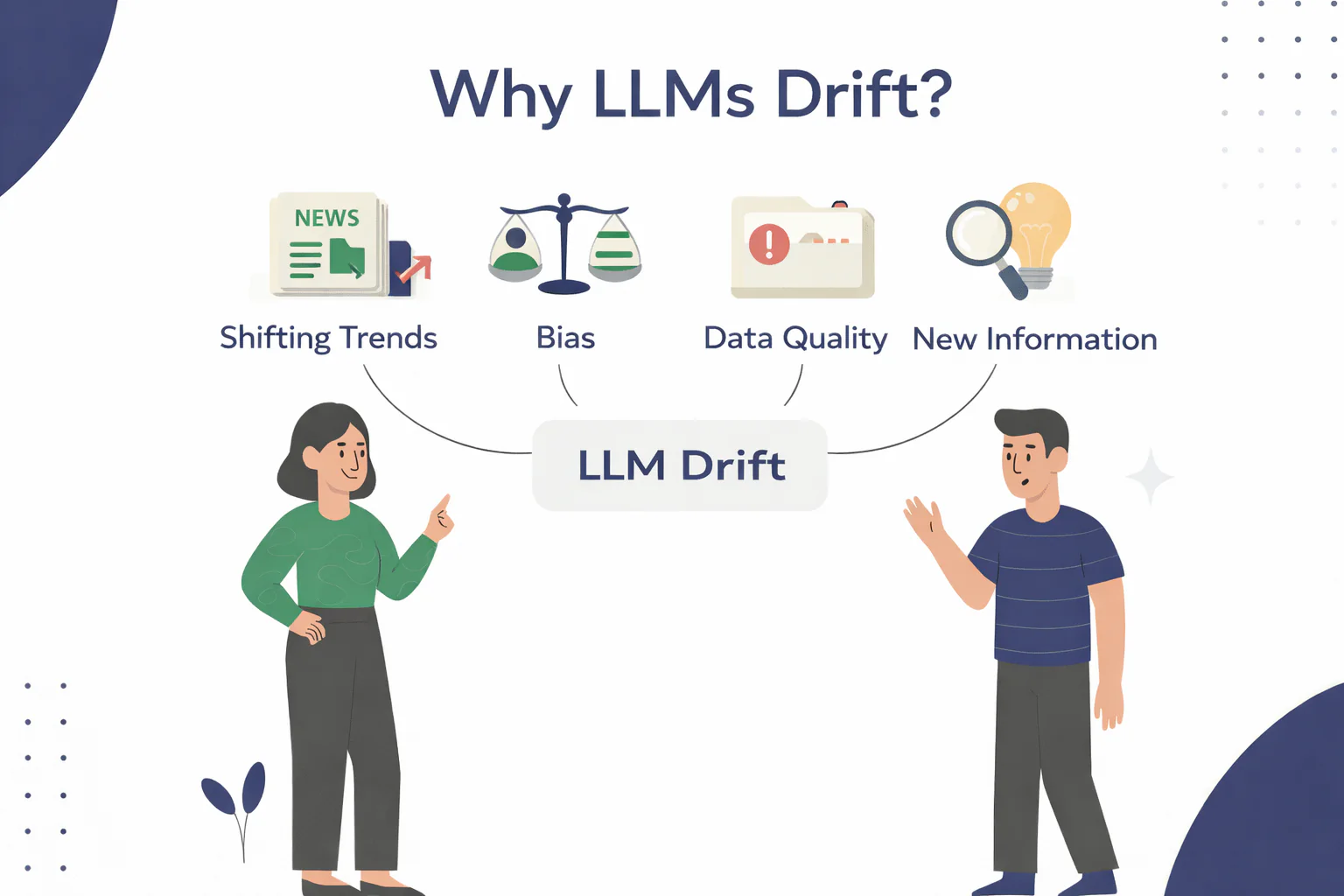
Large language models can produce impressive responses, but anyone who uses them regularly has seen the wobble.
You ask the same question twice and get two different structures, two different tones, or extra details that were never part of your brief.
In my drift research, that kind of variation was measurable. Repeated generations from the same models showed differences in wording, length, and output uniqueness, even under controlled settings.
Introducing: AI drift - what it is and how to reduce it
That matters because a lot of AI workflows assume the model will behave consistently if the prompt and settings are controlled. The research suggests a more cautious view:
• Low-temperature settings can reduce some variation, but they do not make real LLM outputs perfectly repeatable.
• Small changes in phrasing, reuse mode, model choice, and deployment context can still shift what you get back.
• Reliability work needs to measure real outputs instead of relying only on settings that look deterministic on paper.
My recent research looks at this from two practical angles:
• The arXiv drift paper establishes the baseline problem. Repeated real generations can vary, so reliability work needs to test what actually comes back from the model.
• The operator-level prompting preprint tests a possible control layer.
Across more than 1,100 generations, the structured operator produced a much tighter behavioural space than vanilla prompting.
The findings do not claim that drift disappears, but they do suggest that prompt structure can reduce behavioural spread before you reach for heavier interventions such as fine-tuning.
Research links: Quantifying non deterministic drift in large language models and Operator-Level Prompting as Soft Behavioural Control in LLMs.
Understanding data drift and input data instability in LLMs
In machine learning, data drift usually means the data seen in production no longer looks like the reference data used during development. When those statistical properties move far enough, performance suffers. Data scientists can often detect that with tools such as population stability index, statistical tests, and distribution checks.
LLMs have their own version of the problem.
Instead of watching numeric features move, we often notice:
• Tone shifts
• Structural variance
• Different linguistic variations
• Inconsistent constraint adherence
You might see this as a model that changes direction mid-answer, ignores a constraint, or expands a simple prompt into something much broader than intended. Factual accuracy is only one part of the issue. Sometimes the output stops behaving like part of a reliable workflow.
In Quantifying non deterministic drift in large language models, I tested repeated generations from gpt-4o-mini and llama3.1-8b across exact repeats, perturbed inputs, reuse modes, and different temperature settings. The measurements were deliberately practical: unique-output fractions, lexical similarity, and word-count statistics. The key finding was that nondeterministic drift persists in real repeated generations, including at temperature 0.
Not every variation is a failure, but the experiments show why you should be cautious about assuming that low-temperature settings guarantee stable behaviour in a deployed system.
Concept drift: when the model’s internal behaviour shifts
Classical concept drift is about the relationship between inputs and outputs changing over time. In LLMs, that shift can look more like:
• Altered reasoning structure
• New output patterns triggered by subtle changes in phrasing
• Unexpected additions or omissions
• Loss of consistency across similar tasks
Because LLMs are sensitive to prompt wording, context, prior probability shifts, and covariate drift, you need to monitor more than whether an answer is technically “right”. You also need to watch whether the model is still following the expected structure, tone, and task boundaries.
The operator described in my second preprint gives the model a clearer behavioural frame at inference time. Rather than fine-tuning the underlying pre-trained model, it acts as a soft control layer: a structured way to narrow the path from intent to output.
Data drift detection and behavioural signals in LLMs
Traditional drift detection usually watches feature distributions. LLM monitoring also has to deal with structure, language, and behaviour. In the operator-level prompting research, I looked at signals such as:
• Reading-ease metrics
• Word-count variance
• Constraint adherence
• Drift vectors showing movement between behavioural states
• Manifold volume
• Maximum distance between clusters
Those signals give us a way to talk about drift in language outputs without pretending that text behaves like a neat table of numerical features.
In Operator-Level Prompting as Soft Behavioural Control in LLMs, I compared more than 1,100 generations across 120 paired business scenarios. The structured operator produced an approximately 7.4× smaller behavioural manifold than vanilla prompting, along with a centroid shift of 3.35σ in a six-dimensional metric space. Put more simply, the outputs clustered into a tighter and more distinct behavioural region. That is useful evidence for stability, but still best read as practical preprint evidence rather than proof that one prompting method solves LLM reliability on its own.
Drift detection methods for real-world use
Modern machine-learning systems often rely on monitoring dashboards and comparisons with historical data. LLMs make that harder because the “input” is not a stable set of features. Each prompt brings a moving mix of instruction, context, tone, prior messages, retrieved material, and user intent.
The research points to a practical route through that mess. Structural metrics can act as proxies for behavioural stability. Embedding drift can help where semantic movement matters. Recent outputs can be compared with reference behaviours, and prompt-specific variance can be tracked over time. Where possible, explicit feedback should be part of the loop too.
None of this needs to sit apart from existing engineering practice. If you already use regression tests, QA checks, analytics, or monitoring elsewhere in your workflow, the same habit applies here: decide what “good” looks like, then watch for movement away from it.
Drift in LLMs: a dominant source of inconsistency
The papers highlight that much of the day-to-day inconsistency you notice can come from:
• Internal reasoning shifts
• Structural drift
• Stylistic drift
• Prompt misinterpretation
• Distribution shifts in how the model handles language
Rather than large-scale training data drift, this effect happens at inference time as the model moves from intent → category → plan → method → pattern → response. The operator helps by constraining those transitions, reducing the number of places where the output can drift away from the intended behaviour.
In real content workflows, that can mean fewer retries, less manual editing, and a system that feels less like it has to be re-briefed from scratch every time.
Continuous monitoring for long-term LLM performance
Long-term reliability needs the same kind of discipline whether the system is classical machine learning or language-based. Useful practices include human feedback signals, drift dashboards, comparison against reference outputs, and regular checks for distribution shifts. You can also track performance metrics over time, improve retrieval pipelines with better source material, and test whether retrieval augmented generation supports stability in your specific workflow.
The arXiv drift work matters here because it gives you a reason to monitor real outputs instead of trusting API settings alone. The operator-level work matters because it suggests prompt structure can reduce behavioural spread before you reach for heavier interventions such as fine-tuning or pipeline redesign.
That matters operationally: if stability is designed into the prompting layer, you spend less time repeatedly adjusting prompts or correcting avoidable output drift.
What this means if you are building with LLMs
If you are putting LLM outputs into a real workflow, the practical question is not “will the model drift?” It probably will. The better question is: what would drift look like in your workflow, and how would you notice before it creates extra work?
For a content system, that might mean tracking whether outputs are getting longer, losing structure, ignoring source material, changing tone, or needing more human edits than usual. For an internal tool, it might mean checking whether summaries still preserve the right decisions, risks, and next actions. A useful monitoring habit can start small: define expected behaviour, choose a few meaningful signals, and compare new outputs against that reference.
Data augmentation and continuous learning signals
The operator works best as part of a broader stability workflow. You might use data augmentation to improve grounding, collect human feedback as a continuous learning signal, or use online learning systems where adaptation is genuinely needed. Structured prompting tackles a different layer: reducing behavioural drift at inference time. Combined carefully, these approaches can make the system more predictable without turning it into an over-engineered pipeline.
Why this matters in production workflows
Operator-level prompting matters when AI is part of a real workflow, not a one-off experiment. If the structure of outputs drifts, review time increases, handoffs break, and trust in the system falls. Stable prompting, clear review rules, and monitored outputs are what turn a model into a usable operational layer.
If you are building with LLMs, the useful shift is from “the model gave me something odd” to “where would my workflow catch this before it creates extra work?” Drift stops being an abstract model behaviour once it affects your review time, your handoffs, your trust in the system, or the quality of what reaches the person using the output.
Explore operator-level prompting
If you want to go deeper, read the two papers together. The arXiv drift paper establishes the baseline problem: repeated real generations can vary even when settings appear deterministic on paper. The operator-level prompting preprint then tests whether a structured prompt operator can narrow the behavioural space an LLM moves through. One measures the instability; the other explores a practical way to reduce behavioural spread at inference time.
Read the operator-level prompting research: https://zenodo.org/records/17688010
Read the LLM drift and reliability research: https://arxiv.org/abs/2601.19934
Operator-level prompting addresses one kind of drift. Five types of AI drift sets out where it fits among the rest, and our research on production AI reliability covers the monitoring and review that sit around it.
Explore free guides, checklists and templates